Thursday, October 27, 2011

fish bowels and nowhere

Her tears were the voice of God,

spoken audibly

from the drivers seat

of a white Nissan;

sending me to a city

to practice a message of repentance,

reconciliation, salvation;

but grace appeared the enemy.


But now,

as I foot home,

our story smells of burlap,

and sackcloth.

And for my sake,

when you hear it,

good god,

let your pretty heart jump

a little,

if for no other,

than for the

hope,

I have,

it might.


Because I didn’t set my course for Nineveh.

I took a third class to Joppa, and

in the storm named ambitions,

dreams,

found myself asleep,

awake to screams to

summon God.

So when I drew the short straw,

and convinced this crew

my nightmare,

was in fact

the one to cut your wrists for,

they tossed me overboard,

into an ocean called lovesick,

homesick, godsick,

and without knowing it,

but hearing,

the voice in my body

hit the water,

“dear holy god,

if your holy ears

hear

my soul,

then bridge my reach;

swallow me,

neck deep

in fish bowels and nowhere;

but

my knees;”

like standing,

only laying”

and I pray day and night there,

i pray day and night there; and yet,

these hands

could still clench tighter,

this heart

could still know fuller

three days thirst, before

vomiting me onto her shores.

Partida #9: There's coffee in the mountains, and women in coffee, International Women's Coffee Alliance visits El Manzano

Representing multiple areas of the coffee industry, from producers and exporters to importers and marketers; women from around the world gather in El Salvador for the second Annual International Women’s Coffee Alliance, International Convention, from October 25-27.


On Wednesday, 30 of those women journeyed to Sierra Apaneca-Ilamatepec, to explore Finca, Beneficio, and Tostaduria El Manzano, observing the farm, milling, and roasting levels of coffee production.


As stated in their website, the objectives of the convention are threefold, “to increase the visibility of the organization, share knowledge of coffee from seeds to the cup, and promote relations in the coffee sector.” In conjunction and support for their theme, Emilio Lopez, wife Christy, and mother, Margarita Diaz de Lopez, each having experience in the different levels of coffee production, from growing to marketing, welcomed the group.


The day began late morning, in the garden area of the plantation, enjoying El Manzano coffee and pan dulce. From there, the tour began, following the path of coffee from seed to cup, as Emilio led the group through the construction zone of what will become a new patio at El Manzano, allowing visitors to pause for photos of the bright coffee cherries, blushing from the trees planted in route to their first station, the weighing and categorization station, where cherries are weighed and graded for processing.


They then observed the de-pulping station, where cherries are washed and separated by the mechanical syphon, into two qualities of cherries called sinkers and floaters, before passing through an unripe bean separator, where unripe cherries are rejected, and cycled back into the batch of second quality cherries; at which point, both qualities will be de-pulped by vertical machines, and filtered by horizontal rotary screens, which allow normal beans to pass through, while rejecting any beans that did not get de-pulped, is round, or otherwise does not have a flat surface, ultimately resulting in four qualities of parchment coffee; which are washed of their mucilage in water, and channeled into hoppers, and carts, to be spread out onto the patios for drying.


The women were able to walk the patios, as some asked questions, while others kneeled to hold and smell the coffees, taking photos of and with the coffee, or of the small placards marking each batch of coffee processed, listing its complete information, from batch number, to farm and quality. Completing the drying portion of the processing level, were the two horizontal dryers, which the group visited, staring up the long bucket elevators, and into the two furnaces that, fueled by husk, heat the dryers, before pausing for a group picture in front of the patio.


From there the tour entered the hulling portion of processing, as the group walked through the warehouses, already partially filled with parchment coffee from this years harvest, bagged and compiled according to elevation and certification, ready to pass through the hulling equipment, which removes parchment from the green coffee, and separates it with screens according to size, including a newly installed screen for peaberries; at which point the coffee will be ready for export and roasting.


Before the final stop on the tour, the group paused for stories of historic Santa Ana, of weeks journeying, and wagon trains out to the plantation, while imagining what farm life would have been like from 1870 to 1950, before modern roads and efficient transportation. For this reason, a chapel was built to host mass for family and workers throughout their stay at the plantation during harvest, the altar from which however, having now been removed, and replaced with a black, steel, Diedrich IR-12 roaster.


The Roastery at El Manzano is where roughly 10 percent of all the green coffee, processed at Beneficio El Manzano, will end up, where just over half of that 10 percent will be roasted for commercial clients within El Salvador, (i.e. Pollo Campero and McDonalds). The rest will be roasted for speciality customers, distributed to various outlets, (Super Selectos), also within El Salvador.


As the tour came to an end, the group rejoined others in the garden, for lunch and conversation, all accompanied by more coffee and pan dulce, from a famous shop in Santa Ana, bringing an end to an odyssey that began many months ago, as trees shed their flowers and absorbed the seasonal rains and filtered sun, to produce the harvest that brought these women together, now experienced, shared, and enjoyed at every step along the way.


Wednesday, October 26, 2011

Damien Rice - One (U2 cover)


Is it getting better
Do I feel the same
Will it make it easier on me now
I've got someone to blame
You say

One love
One life
When it's one need
In the night
One love
We get to share it
Leaves me baby if I
Don't care for it

Did I disappoint you
With a bad taste in my mouth
I act like I never had love
And I want you to go without
Well it's

Too late
Tonight
To drag the past out into the light
We're one, but we're not the same
We get to
Carry each other
Carry each other
One

Have I come here for forgiveness
Have I come to raise the dead
Have I come here to play Jesus
To the lepers in my head

Beneficio El Manzano: 16 crew, 8 hours, 4 wheels, 2 lightbulbs, and 1 installed horizontal cylindrical dryer

A sixteen man crew, eight working hours, four wheels, three support ropes, two lightbulbs, and one, installed horizontal cylinder for the new Pinhalense SRE-150 mechanical dryer.


There were moments of laughter, amidst others of waiting, measuring, and brainstorming, with reggaeton to fill the patient and often fraught silence, as the crew at Beneficio El Manzano worked into late Tuesday night, in order to install the first of many pieces for the new dryer.


Work began in the afternoon, with two freestanding base supports, and the two ton cylinder in the back of a truck, which needed to go from the latter, into and onto the former.


Using sawhorses to support long pieces of lumber, a makeshift bridge was assembled between the truck and foundation, and wheels were attached to both front and end of the dryer, which they then, rather then lifting, patiently pushed into its suspended position.


Hour by hour, the dryer edged nearer and nearer, until reaching it’s far end brace, where it was then hoisted with a jack, and clamped into position, leaving only the second base to be lifted and bolted into place. As the night set in, a truck was pulled near to cast light on the project, while other crew carried extension cords attached to sockets, and lightbulbs, which shone into the tight spaces where headlights could not reach.


Since the dryer had been suspended in place by sawhorses and lumber, it had to be hoisted again with a jack, allowing the lumber to be sawed in half and removed by hand, making for some tense minutes as the dryer held, suspended, supported only by the first base and a narrow, orange circular jack, which, once both foundations were secured in place, was released, allowing the dryer to rest in its now permanent home.


Ropes were removed, handshakes were extended, congratulations were said, and deep breaths again filled lungs as the day’s work was called and approved, and the feeling of deferred hunger suddenly emerged to everyone’s senses.


Tuesday, October 25, 2011

Beneficio El Manzano: Partida 7 (Here comes the sun)

With Tropical Depression 12-E passed, the clouds have soon emptied and dissipated, bringing the late morning and afternoon's clear sky and sunshine.

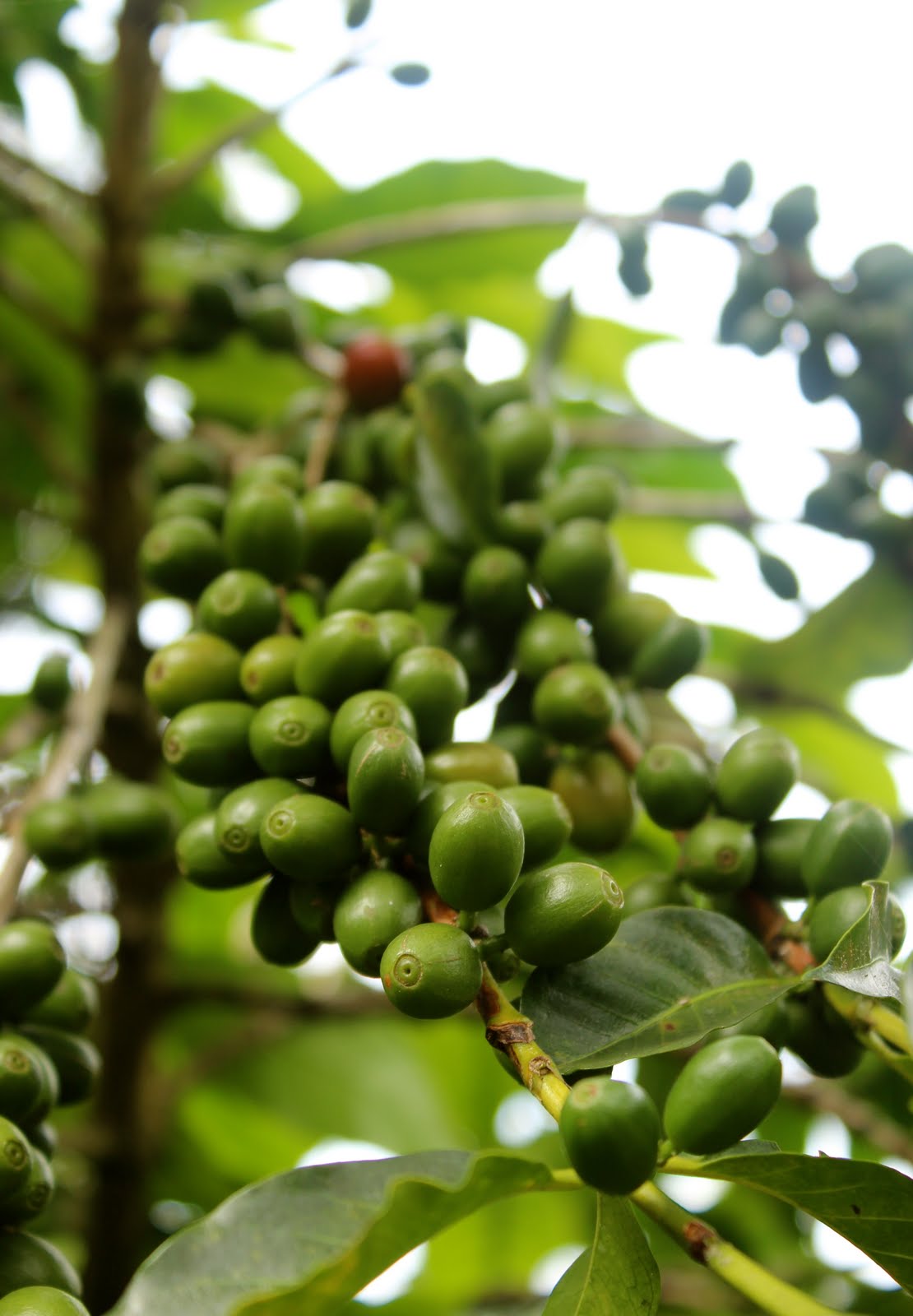
At Finca El Manzano, the new harvest is more visible each day, as cherries begin to show clearly from the trees, intermixed with still ripening beans. Early in the harvest, being a strictly high grown (SHG) plantation, it has begun to be picked, however will not begin full harvesting until December.

While at the mill, seeing some of the effects of the recent rains, many overripe beans make processing more technical and dirty, however, with sunny weather to wake up to, along with a full harvest soon arriving, attitudes are bright and 'cherry.'